minoh terrace | 2024.09
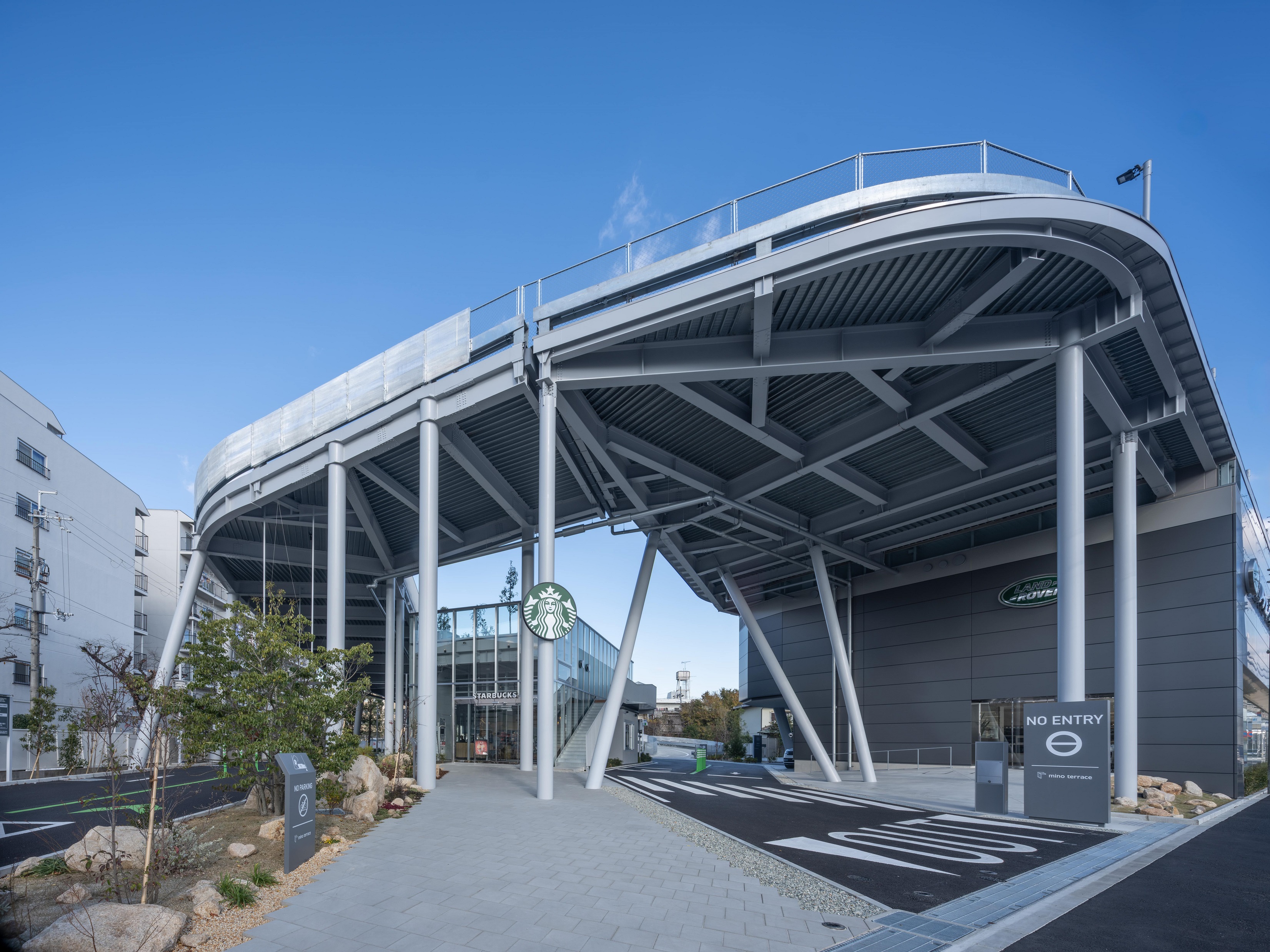


Site
Location:Minoh City, Osaka
Land area:3791.20 m2

Building
Use: Car Showroom and Factory
Structure: Steel
Floor Area: 2373.57 m2
A complex site composed of acute angles.
In Mino, Inaichi’s north south farmland-based grid is intersected by National Route 171 running diagonally northeast
to southwest creating sharp angular sites. Such geometries are often resolved with triangular or curved forms that
neutralise the angle. Here we sought to harmonise our structure with the acute geometry of the site. The previously
divided lot hosted early works by Shuhei Endo and our office. However, due to the aging existing showroom, these were
demolished, to be replaced by a new facility.Conceived over six years ago, the program began as mixed-use facility but
evolved significantly. Ultimately it became clear that the site, program and their environment was shaped by the
automobile. The showroom, drive-thru café, and maintenance facility choreograph a flow of vehicles that defines the space.
The flow of people is also crucial. Visitors descend through a spiralling corridor, encountering a rooftop terrace as they
walk. As battle with our dependence on the car, they must become ecological. Yet it is human behaviour that ultimately
determines environmental outcomes.

The project embraces this reality—aiming to reduce its footprint while influencing the attitudes of those who experience it.
Guided by the principal ‘All flows should flow smoothly’, the design embraces  a‘less is More’ethos—reducing environmental
load, energy consumption, materials, manpower, and time, while enhancing richness, comfort, and the spatial appeal.
A gentle ramp leads to the rooftop parking, seamlessly extending the ground-level lot preserving usable site area. Bellow a
circulation road serves the drive-thru café, with upper circulation overlapping to optimise the footprint. The upper ramp
columns are positioned carefully to avoid obstruction bellow. Their organic placement and slanted orientation yield a
structural rationality that resonates with the spirit of Zen. Beneath the ramp, concrete polygons form the concourse and
approach, absorbing the site elevation change, evoking a rock garden, and a metaphor for impermanence. It becomes a space
imbued with Zen. The rooftop terrace will grow over with greenery, becoming a suspended metaphor for nature within Zen
space-time. Unstable organic soil ruled out piles or ground improvement. The footprint was excavated to a four-meters depth,
then stabilised with mass concrete, an efficient and low impact method. This processed birthed ‘new ground’. Though
artificial platforms were once celebrated, true human activity remains rooted in the real earth. The ground level was
made into public space, where people may move freely, while vehicles circulation was elevated above. The boundary between
typical interior and landscape blurs. The outdoors becomes spatial, while the landscape becomes an interior (human space),
blurring the lines between built and natural environment. It is an artificially rendition of nature. While feeling the
transience of our natural environment, people contemplate its irreplaceable beauty. In the rock garden visitors may find
clarity. As they move along the spiralling slope they feel a sensation of flight. It is not a created form, but a flow that
has taken root and shape. Here lies a terrace that connects to the future.